
Last updated:
Vultr and Polaris School of Technology: Four Years of Cloud Infrastructure for Students and Startups
Building a product is one thing. Getting it online, keeping it running, and making it work for actual users is a different challenge altogether.
For many engineering students, cloud computing remains something they learn through tutorials, classroom exercises, or short-term hackathons. They may build an application, deploy it for a demonstration, and move on to the next assignment. The opportunity to continue developing and running that product is often limited by access to infrastructure.
Polaris School of Technology is looking to change that.
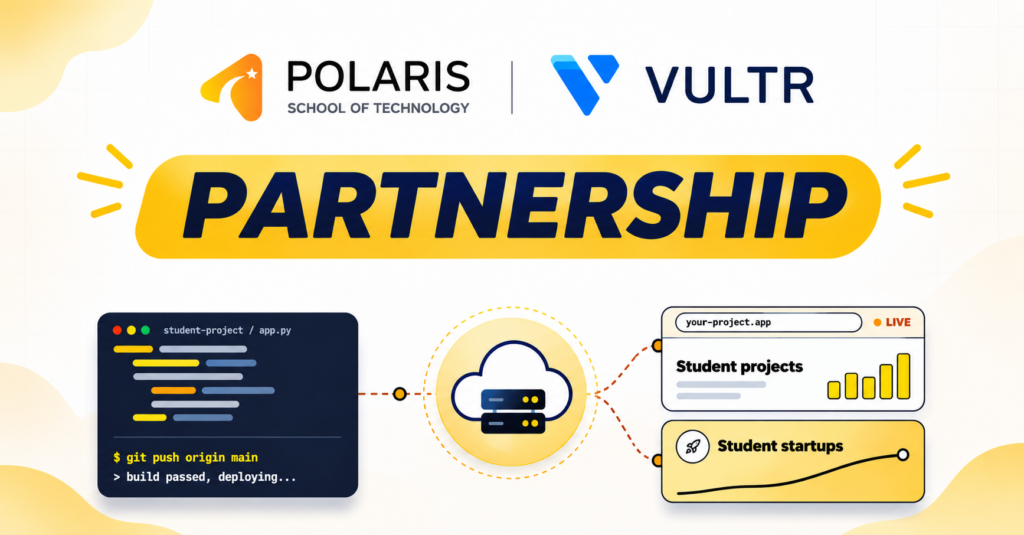
Through its partnership with Vultr, Polaris students and startups will have access to real cloud infrastructure for four years. The idea is simple: give students the resources to move beyond building projects for evaluation and start developing products that can be deployed, tested, and used in the real world.
And unlike the typical college cloud partnership that revolves around a hackathon or a limited-duration credit programme, this initiative is designed to be part of the student experience over several years.
Why Access to Real Cloud Infrastructure Matters?
Learning cloud computing from a textbook is different from working with actual infrastructure.
When students deploy an application, they begin to encounter questions that do not always come up in a classroom. How should the application handle more users? What happens when the server runs out of resources? How can the team manage databases, security, and performance? What does it take to keep a product running after deployment?
These are issues that developers face when they’re creating software for actual users.
“Students given access to cloud infrastructure can explore such questions themselves. They can play around, they can make mistakes, they can fix things and learn how things work behind the applications that people use every day.
For students interested in software engineering, AI, cloud computing or entrepreneurship, this experience can be particularly valuable. They get to work with the environment in which modern products are actually built and operated.
A Four-Year Partnership, Not Just Hackathon Credits
Most students are familiar with short-term technology programmes. A hackathon may provide cloud credits for a few days, or a competition may offer access to tools for the duration of the event.
Such initiatives are useful, but building a meaningful product takes longer than a weekend.
The Vultr partnership with Polaris is designed around a different approach. The infrastructure access extends across four years, allowing students to use cloud resources as they progress through their education.
The scale of the partnership makes this opportunity even more significant. For the next four years, Vultr will be providing $350,000 per year in cloud credits to give students and startups access to the infrastructure they need to build, test, deploy, and scale their ideas. This partnership is a $1.5 million, four-year investment, with cloud credits allocated as follows:
- $150,000 annually for students to work on their OJT assignments, academic projects, and experiments using real cloud infrastructure. Each eligible student can receive up to $300 in cloud credits per year.
- $200,000 annually for startups to develop, deploy, and scale their products without the immediate burden of infrastructure costs. Eligible student-led startups can receive credits ranging from $500 to $10,000, based on their project, performance, and milestones. These credits may also be given as awards in competitions and hackathons.
Polaris will distribute the credits to eligible students and startups pending Vultr’s eligibility checks and review. The partnership also gives Polaris the chance to participate in Vultr’s marketing efforts, and to highlight the work being done by its students and startups.
It also provides the opportunity for longer-term experimentation. Students can revisit projects, improve earlier work, explore new technologies, and take ideas further instead of treating every project as a one-time submission.
The partnership is integrated into how students learn at Polaris, including On-the-Job Training (OJT) and the startup track. Cloud infrastructure is therefore not just an additional benefit; it becomes part of the environment in which students gain practical experience.
From Classroom Projects to Products That People Can Use
A student project often begins with an interesting problem. Perhaps it’s a productivity tool, an AI app, or a platform to make a particular task easier.
But then what happens when the first version is ready?
Students can take the next steps with access to cloud infrastructure. They can deploy their applications, invite people to try them, get feedback, and improve based on real usage.
This changes the way students approach development. Instead of asking only, “Will this work for my submission?”, they begin asking, “Will this work for someone who needs it?”
That shift is important. Product development is much more than just writing code. It has to be about testing assumptions, understanding users, fixing problems, and making decisions as the product evolves.
These experiences can also help aspiring founders learn the technical side of building a startup before trying to launch one.
Supporting the Startup Journey at Polaris
For a startup, infrastructure is not something that can be ignored. Even an early-stage product needs a place to run, store information, and serve its users.
Access to cloud resources can give student founders more room to experiment with their ideas without having to make infrastructure the first hurdle. They can focus on developing the product, testing its usefulness and learning what it takes to build something that people want to use.
The four-year access period is particularly relevant here. Startups rarely develop according to a fixed academic calendar. Some ideas take months to validate, while others need several rounds of development before they are ready for wider use.
Integrating cloud infrastructure into the startup track gives students the opportunity to work through this process during their time at Polaris.
A Different Approach to Engineering Education
The Vultr partnership reflects a larger idea behind engineering education at Polaris School of Technology: students should have opportunities to work on things beyond classroom assignments.
With a four-year cloud infrastructure partnership built into OJT and the startup track, Polaris is establishing an approach that goes beyond the typical short-term cloud-credit arrangement offered around college competitions. To Polaris’s knowledge, no other college in India currently has a partnership of this kind.
The bigger outcome will be what students build with these resources. Applications that move beyond prototypes, projects that evolve through real feedback, and startups that get the opportunity to test their ideas in the real world.
Because learning to build a product should not end when the classroom assignment is submitted. It should continue until someone can actually use what the student has built.