Last updated:
Recently, every few months a new AI tool makes headlines. Behind each one is a team of engineers who turned a promising model into something people can actually use like a chatbot that answers customer queries, a system that flags fraud, an app that reads medical scans, a search feature that understands what you meant. All this work has a name, Applied AI engineering.
If you are a student choosing a career or a parent helping one decide, this guide explains what applied AI engineering is, which skills it demands, what a good curriculum looks like and where it can take you.
What Is Applied AI Engineering?
Applied AI engineering is the discipline of building real, working products and systems using artificial intelligence. An applied AI engineer takes existing techniques and models, such as machine learning, deep learning, natural language processing and large language models and uses them to solve a specific problem for a business or its users.
The focus is on the word applied. The goal is not to invent a new algorithm for a research paper. It is to make AI work reliably in the messy real world, with imperfect data, tight deadlines, cost limits and users who will do unexpected things.
In practice, that means an applied AI engineer will-
- Understand a business problem and decide whether AI is even the right tool
- Collect, clean and prepare data
- Choose, fine-tune or prompt a model
- Wrap that model in software: APIs, databases, interfaces
- Deploy it to the cloud and monitor how it behaves
- Measure quality, fix failures and improve it over time
Applied AI Engineering vs. Related Roles
People often mix up AI roles. The boundaries blur in real teams, but the emphasis differs.
| Role | Main focus | Typical output |
| AI researcher | Inventing new methods and models | Papers, new architectures |
| Data scientist | Finding insights and building predictive models from data | Analyses, dashboards, prototype models |
| ML engineer | Training models and running them at scale | Training pipelines, model services |
| Applied AI engineer | Building complete products powered by AI | Working applications, AI features, agents |
An applied AI engineer sits closest to the product. They need enough machine learning knowledge to make sound choices and enough software engineering skill to ship something that does not break.
Why Applied AI Engineering Matters Now
Two shifts have changed the field. First, powerful pretrained models are now available through APIs and open-source releases, so teams no longer need to train everything from scratch. Second, companies in almost every sector, from finance and retail to healthcare, logistics and education, want to put AI into their products and operations. The bottleneck is not accessing the model anymore; it is the individuals who can create robust systems around the model. This is precisely role that an AI engineer plays.
Core Skills of an Applied AI Engineer
1. Strong programming and computer science foundations
Everything starts here. Python is the main language of AI work, but fluency in data structures, algorithms, databases, operating systems and networking is what separates someone who can follow a tutorial from someone who can debug a production system.
2. Mathematics for machine learning
You do not need to be a mathematician, but you do need working comfort with linear algebra, probability, statistics and basic calculus. These explain why models behave the way they do and help you diagnose them when they do not.
3. Machine learning and deep learning
This includes supervised and unsupervised learning, model evaluation, overfitting, neural networks and the main architectures behind vision, language and recommendation systems.
4. Working with large language models and generative AI
Modern applied AI work leans heavily on LLMs. Key skills include prompt design, retrieval-augmented generation (RAG), fine-tuning, building AI agents that use tools and evaluating outputs that are not simply right or wrong.
5. Data engineering
Models are only as good as their data. Engineers need to collect, clean, store, version and pipeline data and to spot bias and quality problems early.
6. Software engineering and system design
APIs, backend development, version control, testing and designing systems that stay fast and affordable at scale. A model that works in a notebook but fails under real traffic is not a finished product.
7. Cloud, deployment and monitoring (MLOps)
Containers, cloud platforms, CI/CD and tracking model performance after launch. Models degrade as the world changes, so shipping is the start of the job, not the end.
8. Responsible AI
Fairness, privacy, safety, transparency and security. Engineers increasingly need to anticipate how an AI system could fail or be misused and design safeguards from the start.
9. Communication and product thinking
Explaining trade-offs to non-technical colleagues, understanding what users actually need and working in a team. These skills are easy to overlook and hard to replace.
What Should an Applied AI Engineering Curriculum Look Like?
A strong programme builds skills in layers and gives students real projects at every stage rather than saving practice for the end.
Stage 1: Foundations. Programming, data structures and algorithms, web development, databases and the mathematics that underpins machine learning.
Stage 2: Core AI and machine learning. Classical machine learning, deep learning, NLP and computer vision, with hands-on model building and evaluation.
Stage 3: Applied and generative AI. LLMs, RAG systems, agents, fine-tuning and building complete AI-powered applications.
Stage 4: Systems and deployment. Cloud infrastructure, MLOps, scalability, security and monitoring.
Stage 5: Industry immersion. Internships, capstone projects and real product work with industry mentors, so graduates leave with a portfolio, not just grades.
Career Paths in Applied AI Engineering
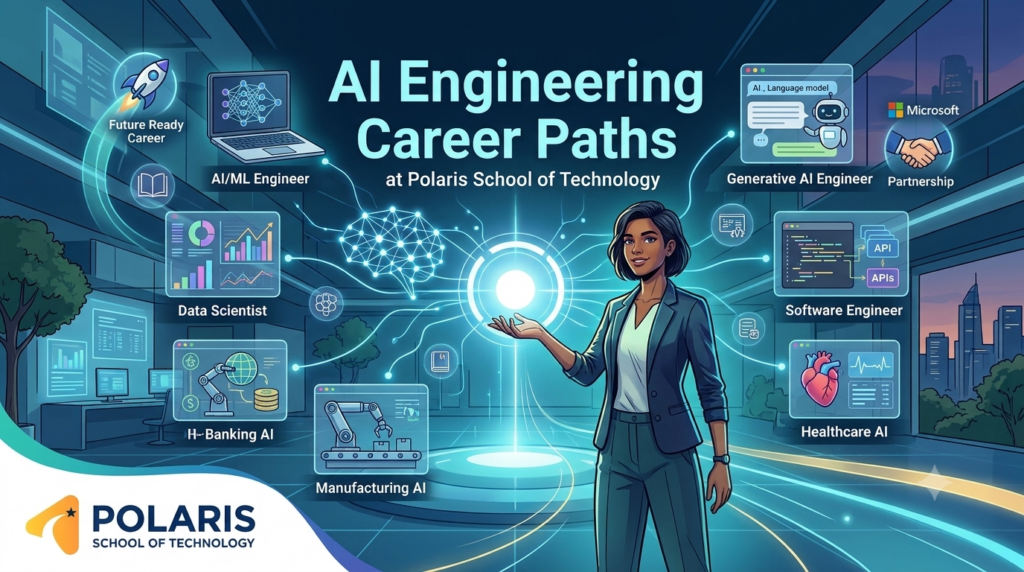
Applied AI skills open several doors. Job titles vary by company, but common paths include:
- Applied AI Engineer / AI Engineer: builds AI-powered features and products end to end
- Machine Learning Engineer: trains, optimises and deploys models in production
- Generative AI / LLM Engineer: works on language-model applications, RAG systems and agents
- NLP Engineer: builds systems that understand and generate human language
- Computer Vision Engineer: works on image and video understanding
- MLOps / AI Platform Engineer: builds the infrastructure that keeps AI systems running
- Data Scientist / Data Engineer: analyses data and builds the pipelines models depend on
- AI Product Engineer or Manager: bridges technology and product decisions
- Startup founder or technical co-founder: many AI products begin with a small team of engineers who can build the whole thing
Is Applied AI Engineering Right for You?
This path tends to suit people who
- Enjoy building things and seeing them work
- Are curious about how intelligent systems behave
- Are comfortable with logic, maths and long debugging sessions
- Like solving real problems more than studying theory for its own sake
- Are willing to keep learning, because tools and techniques change constantly
How Polaris School of Technology Approaches Applied AI
Bengaluru based Polaris School of Technology offers a 4 year B.Tech in Computer Science with a specialisation in AI and ML. The programme begins with programming, data structures and web development. Later it moves into applied AI, cloud systems, product work and industry immersion, so students build engineering depth first and layer AI on top of it.