
Last updated:
Building an institution that shapes the future of education takes more than a vision. It takes years of experience, continuous learning and insights from people who have helped shape the education system themselves.
At Polaris School of Technology, we believe that creating a new approach to engineering education also means learning from those who have spent decades building and leading academic institutions.
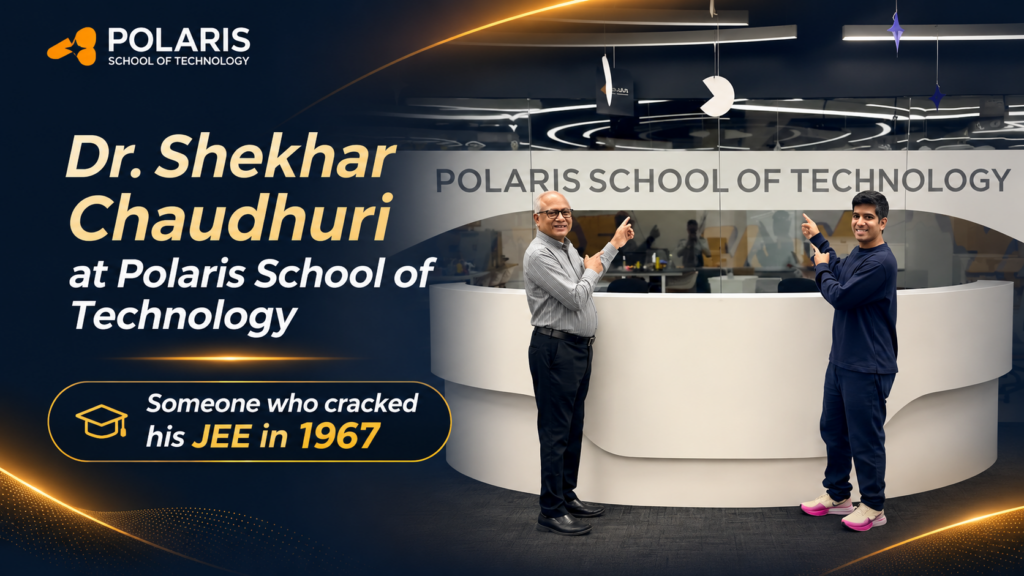
Following from this belief, we invited Dr. Shekhar Chaudhuri, who is former director of IIM Calcutta (2002-2013), to our campus for with our leadership and student body. This visit was quite beneficial for exchanging ideas in relation to academic leadership and institution building.
Dr. Shekhar Chaudhuri: A Journey of Academic Excellence
Professional journey of Dr. Shekhar Chaudhuri is marked by dedication to education and learning. His professional journey started with JEE in 1967 and then joining of IIT Kharagpur. He then joined IIM Ahmedabad and obtained industry experience before entering academia in 1980s. Some significant highlights of his professional journey include
- IIT Kharagpur: Started his professional journey with JEE in 1967.
- IIM Ahmedabad: Gained management education after engineering.
- Industry Experience: Worked in corporate sector before joining academics.
- IIM Calcutta: Acted as Director from 2002 to 2013.
- Academic Contribution: Helped institutions like IIM Ranchi, IIM Ahmedabad, ESCP Business School, Paris and Shiv Nadar University.
Conversations on Education, Leadership and Institution Building
The meeting with Dr. Chaudhuri gave Polaris leadership team time to talk and learn from his work across different schools and colleges. They discussed several key topics and some are stated below.
- What it takes to start a school or college with strong academics and a long-term plan.
- How to keep courses useful as industry needs change.
- His journey from corporate work to a career in education.
- How colleges can help students learn better and prepare for jobs.
- Why experience, vision and long-term thinking matter when running a school or college.
Polaris School of Technology: Different Approach to Engineering Education
At Polaris School of Technology, the goal is to make engineering education closer to real world. Traditional engineering courses often focus on classroom lessons, theory and exams. PST wants to bring technology, hands-on practice, and industry experience to students right from the start of their studies.Some key aspects of the Polaris learning approach have been listed below.
1. Industry-Oriented Learning
It is important for students to understand how technology works outside their books. The Polaris programme focuses on connecting classroom learning with real world use in industry. This helps students build the skills they will need for future careers in technology.
2. Learning with Real Projects
Hands-on experience is very essential in engineering education. Polaris program allows students to gain hands-on learning through projects, construction of products and application of technical knowledge to solve actual problems.
3. Early Industry Orientation
While many other programs introduce industry orientation at the end of the course, Polaris program stresses the significance of early industry exposure to students.
4. Technology Oriented Curriculum
Technology keeps changing, therefore engineering education has to evolve accordingly. Polaris program focuses on new technology fields and skills that will help students cope with demands of the modern technology industry.
5. Learning Outside Classroom
Education not only takes place within the classroom but also in interaction, events, hackathons, industry discussions and collaboration. Polaris program motivates students to gain experience in developing communication, problem solving and collaborative skills.
Special Learning Opportunity for Polaris Students
One of the best parts of the visit was that students got to talk directly with Dr. Chaudhuri. They listened to his experiences, learned about his career and discussed education and professional growth with him. These talks helped in several ways:
- Students learned from people who have worked in higher education for decades.
- Students learned about careers and real stories show how careers change and grow over time.
- Students started thinking wider. Talking with academic leaders helps them look beyond their subjects and exams.
- They felt motivated to keep learning as meeting someone who has spent his life in education shows why curiosity and learning never stop.
Why Interactions with Academic Leaders Matter?
Building a strong school takes time. A school has to learn from systems that already work and it also has to stay open to new ideas. For Polaris, talking with experienced teachers helps it become a place that combines good academics with hands-on, technology-based learning. These talks help the school understand
- What makes a course work well.
- How to build a good learning culture.
- Why students should grow beyond just their grades.
- How to keep up with changing jobs and technology.
- Why a long-term plan matters in higher education.
Building the Future of Engineering Education at Polaris
However, the visit of Dr. Shekhar Chaudhuri was more than that of a campus visit as it was an opportunity for idea sharing and gaining knowledge from years of academic experience in addition to providing students with a different viewpoint which can’t be obtained only from textbooks.
As Polaris School of Technology, we are of the opinion that the future of engineering education will be determined by those institutions who have combined a strong academic background with practical and industrial education.
We would like to thank Dr. Chaudhuri for the time he spent with us along with the experiences that he shared with us.