
Last updated:
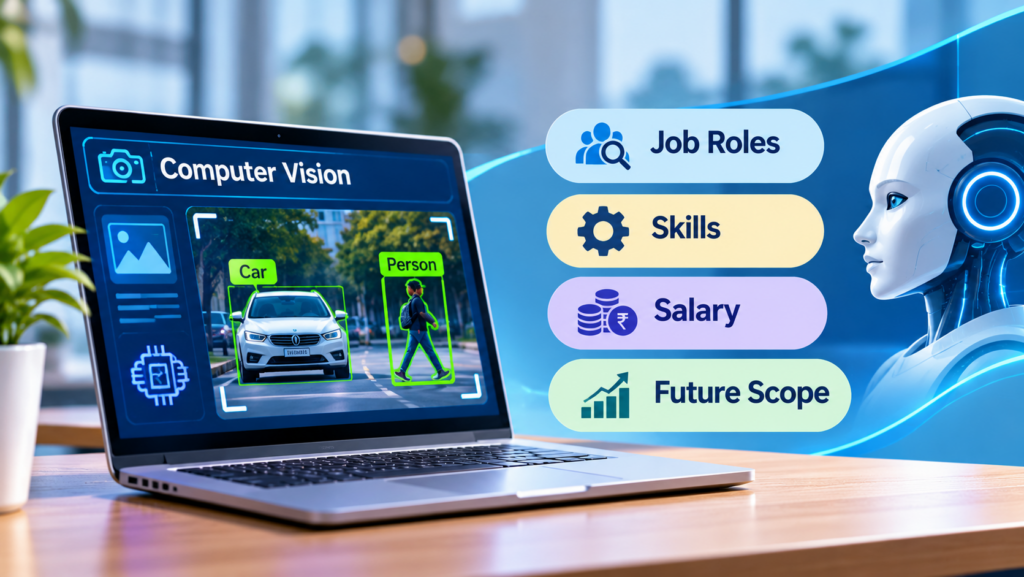
Another emerging career domain in Artificial Intelligence (AI) is Computer Vision, which allows machines to recognise and interpret images and videos. Some of the examples of computer vision applications include self-driving vehicles, facial recognition, medical imaging, and robotic automation. The job opportunities for people having programming and machine/deep learning abilities have emerged, as companies adopt AI-driven technologies. Individuals can consider career options like Computer Vision Engineer, Robotics Engineer, Applied AI Engineer, and Machine Learning Engineer.
If you are a student wanting to make a career out of this subject, you must have strong programming skills and experience with AI models. The Polaris School of Technology offers Bachelor’s degree in Computer Science & Engineering with specialisation in Artificial Intelligence & Machine Learning. This four years long program helps students gain relevant knowledge and skills required for AI jobs.
What is Computer Vision?
Computer Vision (CV) is an application of Artificial Intelligence that helps in processing and understanding images and videos through computing devices. Computer vision is a field of machine application to identify objects, recognise faces, read texts, track motion and perceive surroundings.
For example, the facial recognition that smartphones use to unlock their screen is a technology of computer vision. In a similar way, self-driving cars use computer vision to identify pedestrians, traffic lights, road signs and other vehicles.
Why Choose a Career in Computer Vision?
Computer vision is a field that allows you to work on technologies that change the way different businesses and industries operate. It’s not only research labs as more and more businesses employ visual artificial intelligence to enhance their operations and reduce errors. Polaris School of Technology provides four years Computer Science and Engineering program with Applied AI learning track for students who want to work in this domain.
- Increased use of AI: Many businesses are deploying AI-powered recognition of images, video analytics and automated inspection systems.
- Wide range of opportunities: CV specialists can work in the health care, robotics, automotive industry, manufacturing, retail, agriculture and defence sectors.
- Different career paths: Students will get to explore engineering jobs, research jobs, robotics, machine learning, QA and AI infrastructure jobs.
- Practical approach: Professionals are using it to solve real-world problems, such as spotting road hazards , medical abnormalities and manufacturing defects.
- Area of specialisation: Engineers will be able to specialise in deep learning, 3D vision, autonomy, medical imaging and edge AI.
Go through, AI Engineer Roadmap
Work of Computer Vision Engineer
Computer Vision Engineers develop systems that allow machines to understand images. They work with visual data, machine learning and deep learning to develop software that can recognise objects and process visual information.
- Collecting, cleaning and pre-processing of visual datasets.
- Create image processing algorithms and computer vision models.
- Training and validating deep learning models for recognising images and object detection.
- Developing computer vision systems for face recognition, image classification and object tracking.
- Enhancing the efficiency and efficacy of computer vision models.
- Embedding computer vision models into applications, cameras, robots and other hardware.
- Monitoring and improving the performance of models.
Top Career Opportunities in Computer Vision
Understanding computer vision may unlock many technical roles in the AI and software development industry. The job title and responsibilities depend on the candidate’s specialisation, programming experience and understanding of machine learning.
1. Computer Vision Engineer
A Computer Vision Engineer creates and applies algorithms that allow machines to understand visual information. They apply image processing, machine learning and deep learning models to create applications for different industries.
- Build recognition of images and object detection models
- Use with image and video data sets
- Utilise computer vision libraries to process visual data
- Train and optimise deep learning models
- Implement computer vision solutions in real world applications
Skills Required: Python, OpenCV, PyTorch, TensorFlow, Machine Learning, Deep Learning.
2. Applied AI Engineer
Applied AI Engineers apply AI to solve the problems faced by businesses and industries. Computer vision professionals develop computer vision applications using AI models like automated surveillance, intelligent image inspection and intelligent recognition of images systems.
- Computer vision model design for AI applications
- Integrate machine learning algorithms into software products
- Contribute to the designing of image and video analytics systems
- Improve model performance
- Collaborate with software engineers and data scientists
Skills required: Python, machine learning, deep learning, PyTorch, TensorFlow, computer vision and software development.
3. Robotics and Perception Engineer
A Robotics Engineer focused on perception builds systems that help robots understand what’s going on around them. These systems are equipped with cameras and other sensors to identify objects, measure distance and detect movement.
- Build visual perception systems for robots
- Work with object tracking and 3D computer vision
- Fusion of camera, radar and Lidar data
- Develop algorithms for traversing and detecting obstacles
- Improve systems for real-time perception and decision making
Skills required: C++, Python, OpenCV, ROS, 3D computer vision, sensor fusion and linear algebra.
4. Machine Learning Engineer
A Machine Learning Engineer creates models and algorithms which enable computer systems to learn from data. In computer vision tasks, they develop and train models to categorize images, detect objects and recognize patterns.
- Training of models through machine learning
- Analysis of data sets
- Using algorithms for Deep Learning
- Model performance evaluation
- Deploying trained models into application
Skills required: Python, machine learning, deep learning, statistics, PyTorch, TensorFlow and data processing.
Check, AI vs Machine Learning vs Generative AI
5. Computer Vision Researcher
A Computer Vision Researcher works on creating new methods and algorithms to better enable machines to understand visual data. These qualified individuals may work in research laboratories, universities, technology companies and AI research teams.
- Explore new computer vision algorithms
- Create and evaluate deep learning structures
- Study techniques for recognition of images, segmentation and object detection.
- Assess the existing models and suggest improvements
- Publish research results and work with technical teams
Skills required: Mathematics, Python, machine learning, deep learning, computer vision and research methodology.
6. Computer Vision QA Engineer and Data Specialist
Computer Vision QA Engineers and Data Specialists help ensure that visual AI systems work accurately. They evaluate image datasets, check annotations and test whether computer vision models produce reliable results.
- Review and organise image and video datasets
- Check image annotations and object labels
- Evaluate bounding boxes and segmentation masks
- Identify errors in model predictions
- Test computer vision applications under different conditions
Skills required: Image processing, Python, data analysis, machine learning fundamentals, dataset annotation and testing.
7. MLOps and Embedded Computer Vision Engineer
Embedded Computer Vision MLOps and Computer Vision Engineers deploy and manage computer vision models in practical use cases. They make sure the AI models run correctly on different hardware like cameras, robots, cars, and edge computing devices.
- Deploy computer vision models to cloud and edge computing infrastructure
- Optimise the models for faster inference
- Work with embedded hardware, GPU based hardware systems
- Control the performance of deployed models
- Create automation pipelines for testing and deploying models
Skills required: Python, C++, CUDA, Docker, Kubernetes, ONNX and TensorRT.
Go through, MLOPs Careers 2026
Industries That Hire Computer Vision Professionals
Computer vision is used in industries where machines need to analyse images, videos or visual information. This creates opportunities for engineers to work across different sectors.
| Industry | Applications of Computer Vision |
| Healthcare | Medical image analysis, tumour detection and diagnostic imaging support |
| Automotive | Driver assistance, autonomous driving and pedestrian detection |
| Manufacturing | Product inspection, defect detection and quality control |
| Retail and E-commerce | Visual search, product recognition and inventory monitoring |
| Agriculture | Crop monitoring, disease detection and automated harvesting |
| Banking and Finance | Document verification, cheque processing and identity verification |
| Security and Surveillance | Object tracking, video analytics and intrusion detection |
| Robotics | Object recognition, navigation and obstacle detection |
| Defence and Aerospace | Aerial image analysis, surveillance and autonomous systems |
Computer Vision Engineer Salary in India
The salaries of Computer Vision Engineers in India depend on several factors such as experience, skill set, location, size of the employer and complexity of the projects handled. Deep learning, C++, GPU optimisation and model deployment working experience candidates can expect to earn high salaries.
According to the available data on salaries, fresh computer vision engineers can expect a salary of between ₹5-10 LPA. Nevertheless, there are differences among employers.
| Experience Level | Approximate Annual Salary |
| Fresher / Entry Level (0–2 years) | ₹5-10 LPA |
| Mid-Level (3–5 years) | ₹10-20 LPA |
| Experienced (5–8 years) | ₹15-30 LPA |
| Senior-Level (8+ years) | ₹20-40 LPA or more |
How Polaris School of Technology Prepares Students for AI Careers?
However, for students who are looking forward to making their careers in computer vision, it is recommended that they start by building an understanding in computer science, artificial intelligence, and machine learning. Computer vision engineering involves building and deploying artificial intelligence applications and experience plays a crucial role in doing so.
The Polaris School of Technology in association with Medhavi Skills University offers a 4 years Bachelor of Technology (Undergraduate) degree program in Computer Science and Engineering with specialisation in Artificial Intelligence and Machine Learning.
- Programming and Software Development: Basic programming languages and their use in data structures and algorithms and software development.
- Artificial Intelligence and Machine Learning: Learn how artificial intelligence applications learn from data and how machine learning techniques can be applied to solve real-world problems.
- Practical learning: Application of concepts learnt in the classroom in practical learning, through projects and other industry related activities.
- Industry Exposure: how tech companies build products and solve real-world engineering problems.
About Computer Vision Careers FAQs
1. Is computer vision a good career?
Yes. Computer vision is a specialised career discipline in artificial intelligence and machine learning. You can have a job in automotive technology, health care, robotics, manufacturing, retail and security. This career enables working in engineering, research, modelling and deployment of AI.
2. What is the job description of a Computer Vision Engineer?
The job profile of a Computer Vision Engineer includes designing and developing models for understanding pictures, videos and more. They take care of things like image processing , object detection , face recognition , image classification etc.
3. Do you have any openings for freshers, in computer vision?
Yes, freshers can apply for jobs in AI, machine learning and computer vision. But some engineering jobs may be specialised and require prior job experience.
4. Is it possible to get a job as a Computer Vision Engineer with only Python?
Python is a good starting point, but there are other aspects to address such as image processing, machine learning, deep learning and mathematics. Learning C++ will help in real time computer vision application.
5. Which subjects should students opt for after completing Class 12 for a career in Computer Vision?
Students aspiring to have a career in computer vision should opt for Computer Science Engineering, Computer Science and an undergraduate course in Artificial Intelligence and Machine Learning . Students need to learn python, mathematics, machine learning and deep learning and work on projects.

