
Last updated:
You’ve probably seen all three terms, AI, generative AI, and machine learning, used as if they mean the same thing. News headlines, product launches, and job postings throw them around interchangeably. They are from the same family but have different superpowers, and knowing how they fit together makes it much easier to understand the technology shaping our world. We have discussed the major differences between Artificial Intelligence, Generative AI and Machine Learning in the article below.
What is AI?
AI (Artificial Intelligence) is a broad goal of making machines behave exactly like humans in such a way that it seems intelligent and acts smart. The term “AI” was coined in 1956, and early AI systems didn’t learn anything at all. This includes reasoning, solving problems, understanding different language, recognizing images and making decisions. It is a goal, not a single technique.
Let us understand it with a simple example:
Think of a basic chess game on your mobile phone. The programmer wrote rules like “if the opponent does this, do that.” The game isn’t learning anything, but it still seems smart. That is AI.
Apart from this, there are many different day-to-day life examples explaining AI including
- Google Maps finding the fastest route
- Voice assistants like Siri or Alexa
- Face unlock on your phone
| Artificial Intelligence (AI) = machines doing smart things |
What is Machine Learning?
Machine learning is a subgroup of AI where machines learn patterns from data instead of being directly programmed with rules.
In simpler language, think about how you’d teach a child to recognize a dog. You don’t hand them a rulebook saying “four legs, fur, tail, barks.” You show them many dogs, and eventually they just get it. It’s the same for Machine Learning: you just need to feed an algorithm lots of examples, and it finds the patterns on its own. Some of the most common examples of machine learning are the notifications sent on your mobile in day-to-day life:
- YouTube and Netflix recommendations.
- Your bank detecting a suspicious payment.
- Delivery apps predicting how long your food will take.
| Machine Learning (ML) = machines that learn from data |
What is Generative AI?
Generative AI is a type of machine learning that is used in creating new content, such as text, images, audio, video and code, rather than just analyzing or classifying existing data.
Traditional machine learning is mostly analytical, as it looks at data and then tells something about it: “This email is spam,” “This customer will likely churn,” “This X-ray looks abnormal.” On the other hand, Generative AI is much more creative. You give it a prompt, and it produces something that didn’t exist before.
Let us understand Generative AI with a simple example: Just type “Write a short story about a robot who loves cricket,” and the AI will write a brand new story that did not exist before.
Apart from this, there are many more day-to-day life examples explaining Generative AI including:
- Chatbots like Claude and ChatGPT that answer questions and help with homework
- Tools that turn your words into pictures
- AI that helps write and fix computer code
| Generative AI = machines that create |
Difference Between AI, Machine Learning and Generative AI
Here we have discussed a detailed table explaining key differences between artificial intelligence, machine learning, and generative AI.
| Difference Between AI, Machine Learning and Generative AI | |||
| Feature | Artificial Intelligence (AI) | Machine Learning (ML) | Generative AI |
| What is it? | AI is a broad field that makes machines act smart. | It is part of AI where machines learn from data. | It is a part of AI that uses learned patterns to create new content. |
| Simple definition | AI is a machine that can think or decide | Machines that learn from examples. | Generative AI is a machine that creates new things. |
| Main goal | Its main goal is to imitate human intelligence | To find patterns and make predictions | Main goal of generative AI is to create text, images, music, videos or code |
| How does it work? | Uses predefined rules or learns from data | Analyzes data to identify patterns | Learns patterns from large amounts of data and uses them to generate new content |
| Does it need data? | Not always | Yes | Yes |
| What does it give as output? | Decisions or actions | Predictions or classifications like spam or not spam | New content like essays, images, songs or code |
| Is output new? | Follows predefined rules or instructions | Predicts or classifies based on learned patterns | Generates new combinations of content as per learned patterns |
| Real-life example | A chess game | An email spam filter | ChatGPT or Claude generating an essay |
| Uses | Google Maps, face unlock | Netflix recommendations, fraud detection | Chatbots, AI image generators, coding assistants |
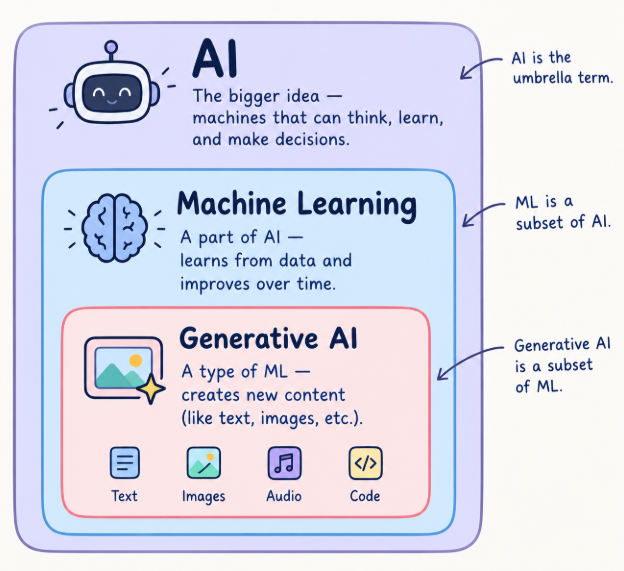
How They Relate To Each Other?
As all three artificial intelligences, machine learning and generative AI are from the same family, they possess a few similarities. We have explained how they relate to each other in the article below.
They are like boxes inside boxes
Artificial intelligence (AI) is the biggest box. ML is a smaller one inside it. While Generative AI is an even smaller box that fits inside ML.
AI is the main idea
AI just means making a machine act smart.
ML is one way to make AI
In machine learning computer learns from examples instead of following rules written by any person.
Generative AI is a kind of ML
Generative AI also learns from examples, but it goes one step further: it creates new things like stories, pictures, music and much more.
One-way connection
- Generative AI is always ML.
- ML is always AI.
- But AI is not always ML and ML is not always Generative AI.
They can work together in one app.
In a food delivery app:
- AI is the whole smart app.
- ML guesses your delivery time.
- Generative AI writes the chat reply to your question.
AI vs Machine Learning vs Generative AI: FAQs
Ques 1: What is most common difference between AI, machine learning, and generative AI?
Answer: Machine learning predicts or sorts what already exists, while Generative AI creates something new. And AI is an umbrella that covers both.
Ques 2: Define Artificial Intelligence.
Answer: Artificial Intelligence (AI) is equal to a machine doing smart things.
Ques 3: Give me a few everyday examples of Generative AI.
Answer: Chatbots, AI image generators and coding assistants are some of best examples to understand Generative AI.
Ques 4: What is machine learning?
Answer: Machine Learning (ML) can be simply understood as a machine that learns from data to find patterns and make predictions accordingly.