
Last updated:
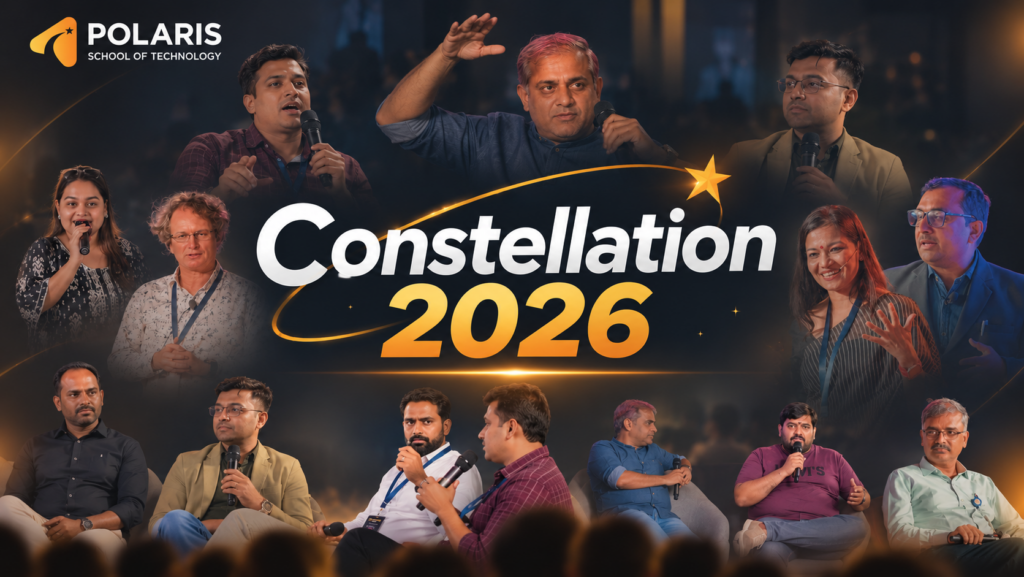
What happens when the next generation of engineers gets the opportunity to learn directly from the people building the future of technology? Constellation 2026 at Polaris School of Technology brought that experience to life, bringing together industry leaders, innovators, entrepreneurs, and researchers for three days of inspiring conversations, hands-on experiences, and unforgettable campus celebrations.
Constellation 2026, an event held to welcome the new group of engineering students, was far more than a typical college orientation. It placed students face-to-face with the very professionals they want to work with in the next 4 years and beyond. The event featured leading leaders, innovators, and technology experts from ISRO, AWS, Salesforce, Microsoft, Atlassian, Google, LinkedIn, Z47, HCLTech’s NVIDIA ecosystem, and other leading organisations, giving students an early glimpse into the world of engineering, artificial intelligence, space technology, entrepreneurship, and global innovation.
From understanding what it takes to build successful products and scale AI solutions to exploring startup journeys, robotics, and real-world engineering challenges, every session brought fresh perspectives to students beginning their computer science journey. Beyond the industry interactions, the 3-day event came alive with student innovation showcases, interactive workshops, campus activities, cultural performances and a live concert.
What is Constellation 2026 at Polaris School of Technology?
Polaris School of Technology organised a three day tech-cultural and orientation event for the incoming engineering students named Constellation 2026. The event comprised of industry interactions, hands on workshops, innovation showcases and cultural celebrations. Industry professionals gave students practical insights into artificial intelligence, software engineering, space technology, entrepreneurship and new career opportunities. The event also featured student-built projects, hands-on technical demos and campus club activities, in addition to expert discussions. Students got to explore their interests, meet seniors and the learning culture at Polaris School of Technology.
Event Highlights at Constellation 2026
The three-day event included a variety of activities such as expert-led sessions, technical workshops, student innovation showcases and cultural performances. Here is a brief rundown of the major highlights and the organisations involved.
| Particulars | Details |
| Event Name | Constellation 2026 |
| Organised By | Polaris School of Technology |
| Location | Bengaluru, Karnataka |
| Event Type | Orientation and Tech-Cultural Festival |
| Duration | 3 Days |
| Major Focus Areas | AI, Software Engineering, Space Technology, Startups, Robotics, Career Development and Innovation |
| Industry Representation | ISRO, AWS, Z47, Salesforce, Atlassian, Microsoft, Google, LinkedIn, ClickHouse, HCLTech, Blume Ventures and more |
| Major Activities | Industry Talks, Hands-on Workshops, Innovation Showcase, Club Introductions, Cultural Performances and Concert |
Constellation 2026 Day 1: From Space Technology to Building Real-World Products
The first day of Constellation 2026 set the tone for the event with sessions featuring experts from ISRO, Amazon Web Services, Z47, Asper AI, and the Australian National University.
Among the topics that have been talked about is the interface between scientific discoveries, technological innovation, and the engineering profession itself. It provided some early insights for the engineering students on how their studies could be used in practice.
M.K. Murahari, Group Head, ISRO: Building a Career in Space Technology
Some of the speakers who were present during the first day were M.K. Murahari, Group Head, ISRO (Indian Space Research Organisation). He spoke about developing a career in space technology. It was an interesting session for students, giving them an idea of how the combination of engineering, research, and technology can work together in one field.
It was especially useful for students who are interested in pursuing careers in the field of engineering. Not only did it provide them with an alternative view to software careers, but it showed them that in order to pursue such a career, knowledge of science and technology along with problem-solving skills is required.
Rohit Sharma, AWS: Turning an Idea Into a Shipped Product
A session by Rohit Sharma from Amazon Web Services (AWS) covered the process of taking an idea and turning it into a tangible product that goes out to end users. The topic highlighted a basic issue in the field of technology, which is to get beyond mere conceptualization and go into implementation.
It provided a starting point for the future engineers regarding the process of going from an idea or a concept discussed on the whiteboard to the actual implementation and deployment of the product..
Prakash, Senior Director of Engineering, Asper AI: Learning Through a Hands-on Workshop
Day 1 also featured Prakash, Senior Director of Engineering at Asper AI, who conducted a hands-on workshop involving students and parents. Unlike conventional speaker sessions, the workshop introduced a more interactive element to the event, encouraging participants to engage directly with the learning experience.
The inclusion of parents was particularly meaningful during orientation, as it created an opportunity for families to participate in an engineering-focused activity alongside incoming students.The workshop reflected the event’s emphasis on practical engagement and learning through participation.
Rupali Sharma, Managing Director, Human Capital, Z47: What Makes Young Talent Stand Out?
Rupali Sharma, Managing Director – Human Capital, Z47, tackled the very relevant topic of what distinguishes a fresh recruit from the crowd in terms of making a good impression on employers in the tech world, a topic which is very relevant for students just about to join the corporate world.
For first-year engineering students, it was eye-opening for them to realize that their professional development was something which needed consideration even prior to their placement season.
Matthew Hole, Professor, Australian National University: Understanding World-Class Scientific Research
Professor Matthew Hole from the Australian National University (ANU) brought an international academic and research perspective to Constellation 2026. His session focused on how world-class science is built, giving students insight into the research process and the importance of scientific exploration.
The conversation opened up another dimension of engineering education – that of getting involved in research and scientific discoveries. Through Day 1’s combination of both industry and academic points of view, it was shown that engineering careers encompass the design process, scientific discovery, space science, and the newest industries.
Constellation 2026 Day 2: 11 Industry Speakers, Big Ideas and the Future of Engineering
Day 2 of Constellation 2026 brought together 11 speakers representing global technology companies, startups, and engineering communities.
With professionals associated with Salesforce, Atlassian, Microsoft, ClickHouse, HCLTech’s NVIDIA ecosystem, InfoEdge, Levi Strauss & Co., Slice, Hoopr, insideFPV Drones, and Smartly Labs, the day explored what it means to build a career in an industry undergoing rapid technological change.
Govinda Sambamurthy, SVP Engineering, Salesforce, and Puneet Patwari, Principal Engineer, Atlassian
On Day 2, Govinda Sambamurthy, SVP Engineering at Salesforce and Puneet Patwari, Principal Engineer at Atlassian, had a talk about what makes engineers recruited, promoted, and rewarded in tech companies.
This particular talk gave a chance for students to see what is involved in the career of an engineer beyond programming at the entry level. For students who dream of working in software development for many years, such topics as technical knowledge, career growth, and necessary skills were of great relevance.
Deyvant Bhardwaj, Co-founder, insideFPV Drones: Building Hardware in India Against the Odds
The Co-founder of insideFPV Drones, Deyvant Bhardwaj, explained his entrepreneurial experience and the difficulties faced in developing a hardware-oriented business in India. insideFPV Drones is a startup based on drone technology, which was also part of Shark Tank India, and it had a different kind of entrepreneurial story compared to the software-oriented businesses that commonly come up during technology talks.
From a student perspective, this discussion helped understand the challenges involved in creating tangible technology products and the determination needed in pursuing out-of-the-box ideas. There are also career options for engineers with a liking for drones and electronics.
Siddhant Agarwal, ClickHouse, and Shivendra Yadav, HCLTech: Scaling AI Beyond Local Development
ClickHouse’s Senior Developer Relations Advocate Siddhant Agarwal and HCLTech’s CTO NVIDIA Ecosystem Shivendra Yadav talked about the aspects needed for deploying artificial intelligence beyond local development into large-scale implementations. The talk was based on a growing difference in software engineering where developing an AI prototype doesn’t mean creating a working system that will be able to run at scale.
Students received information on the engineering tasks involved in the development of real-life AI applications. With AI playing an ever-growing role in software development and enterprise technologies, this talk provided a glimpse into technical skills needed to create reliable systems.
Anubha Maneshwar, Founder, Smartly Labs and GirlScript Foundation: Building Careers Through Open Source
Anubha Maneshwar, Founder of Smartly Labs and GirlScript Foundation spoke on the importance of being part of the open-source community in growing your career. Her session focused on how being part of collaborative technology communities can help with learning, networking and career building.
The open source community is where budding engineers can contribute. It is a place where you can learn and get hands-on experience by working with other programmers.
Alekhya Chakrabarty, Senior Vice President, InfoEdge: Why Curiosity Cannot Be Automated
In addition to a talk on the story and strategy behind her book, Alekhya Chakrabarty, Senior Vice President at InfoEdge, gave a unique outlook to the event by introducing the concept of the reason behind the importance of curiosity not being automatable.
During an era where artificial intelligence is able to create information and help out with many tasks, this talk helped the students appreciate the significance of formulating insightful questions and having independent thoughts. Curiosity will always remain important for future engineers as it helps them understand problems, explore new concepts and innovate.
Venkatesan Vaidhyanathan, Chief Architect, Slice, and Omkar Srivastava, Head of Applied AI, Levi Strauss & Co.
Venkatesan Vaidhyanathan, Chief Architect of Slice, and Omkar Srivastava, Head of Applied AI at Levi Strauss & Co., compared greenfield and legacy environments in terms of engineering.
The Greenfield environment is usually characterized by the creation of something completely new, whereas legacy environments mean that engineers have to develop something within existing technology infrastructure. Thus, it became clear why different methods should be used in these cases. From the standpoint of students, this talk was an introduction into the sphere of software architecture..
Anish De, SDE 2, Microsoft: Balancing Career, Academics and Personal Life
In his talk, Anish De, an Engineer 2 at Microsoft, focused on the issue of managing one’s career aspirations, studies, and personal life.
He talked about an aspect of engineer education that is generally overlooked in the discussion of technical skills and job prospects. Engineers must generally deal with a variety of conflicting interests including coursework, coding, projects, internships, and extracurriculars.
Meghna Mittal, Co-founder, Hoopr: Building Something That Did Not Exist Before
In her talk about entrepreneurship in emerging markets, Meghna Mittal, co-founder of Hoopr, enlightened the students about the process of coming up with a product.
This session was aimed at making something out of nothing, making the students understand the difficulties and possibilities that are inherent in such processes as innovation. Not only does coming up with a product involve execution, but it also entails many other things such as finding a need, solving it, understanding the users, and adjusting your product according to your growth.
Constellation 2026 Day 3: Career Choices, Robotics, Startup Culture and Global Opportunities
The third day of Constellation 2026 continued the industry interactions while introducing students to campus clubs, student activities, and cultural performances.
Polaris’s official event recap highlighted speakers from LinkedIn, Blume Ventures, and CODE Berlin. The day brought together conversations about professional identity, startup careers, robotics, global opportunities, and the changing expectations of technology employers.
Anubhav Sethi, Software Engineer, Google: From Developer to Thought Leader
Anubhav Sethi, Software Engineer at Google, delivered a session described by a student attendee as From Developer to Thought Leader.
This demonstrated the importance of forming an identity as a professional, apart from mastering the technical skills. In the case of future engineers, it served to instill an appreciation of the part played by communication and community formation alongside programming.
Pallab Sarkar, VP of Engineering, ATI Robotics: From Code to Robots
Pallab Sarkar, who is the VP of Engineering for ATI Robotics, talked about the shift from programming to creating systems that interact with the physical environment.
The talk, which, as explained by the students, was titled From Code to Robots, revolved around the subject of robotics and how one can acquire the skill set needed for solving practical engineering problems.
Meghna Swami, LinkedIn, and Saaquib Dawoodani, VP of Talent, Blume Ventures
Meghna Swami of LinkedIn and Saaquib Dawoodani of Blume Ventures, who is the VP of Talent, talked about the practicality of working in startups in comparison to existing organizations.
The conversation analyzed the differences in responsibility, learning and risks based on the organization’s size and stage. In startup firms, individuals have the chance to work in various departments and do things which go beyond their actual job description.
Manuel Dolderer, Co-founder, CODE Berlin: Exploring Global Pathways
Manuel Dolderer, Co-founder at CODE Berlin, helped students discover opportunities in technology education and career paths on an international scale.
The international aspect introduced by Manuel’s presentation motivated students to explore possibilities beyond their present educational environment. Given that technology careers are now becoming more international in nature, it became necessary for the students to explore these ecosystems.
The Grand Finale: Gini’s Live Concert and a Campus Celebration
The celebration at the end created another mood at Constellation 2026.
After the sessions and performances, the event included a sundowner performance by Gini, and then followed by DJ celebration.
Students came to celebrate through music and performances as they were marking the end of the three-day orientation program. There was also a robotics demonstration and mural wall for the Class of 2030 at the end of the day. In addition to the first day’s sessions and introductions, the end of Constellation 2026 was a time when the incoming students got a chance to learn about Polaris’ culture.
What Made Constellation 2026 Different From a Traditional College Orientation?
Constellation 2026 was unique for its focus on bringing students closer to the professional side of life right from the start of their engineering studies. Instead of limiting itself to purely educational purposes, this program allowed students to see the practical side of working as an engineer through professional challenges and examples.
Having speakers from space research, cloud computing, AI, corporate technologies, startups, and venture capital gave students many options to look at the different ways they could develop professionally. This program proved that studying is not limited to lecture halls only – practical workshops, student projects and community events showed how all this could complement each other.
Beyond Technology: Campus Clubs, Creativity and Community
Constellation 2026 was also designed to help incoming students become familiar with the social and cultural environment at Polaris School of Technology. Throughout the 3 days, students interacted with seniors, explored campus clubs, participated in informal activities, and met fellow members of the Class of 2030. It has got welcome-desk activities, group caricatures, interactions with senior project teams and opportunities to explore student-built technology. On the final day, campus clubs took centre stage through introductions and cultural performances.
The combination of industry experts, technological innovations, and the creativity of the students made Constellation 2026 a captivating initiation into the field of engineering. The lectures, hands-on workshops, innovation showcase, and other cultural activities provided the students with various learning opportunities. This helped the students to get acquainted with the professionals of the industry and get familiarized with its requirements. Thus, Polaris School of Technology provided students with new ideas for starting their college life.