Last updated:
A few years ago, learning artificial intelligence usually meant starting with machine learning, studying algorithms and spending considerable time training models. Today, you can build an application using an AI API without training a model from scratch. That has made AI development more accessible, but it has also left beginners wondering what they should actually learn.
Should you start with Generative AI? Is Python still necessary? Can you skip machine learning and move straight to Large Language Models (LLMs)?
If you want to get a job as an AI engineer, it helps to understand how these technologies fit together. You don’t need to learn it all at once, but if you skip the fundamentals, it can be hard to understand what is going on when an AI application gives an incorrect or unexpected result.
First, know what an AI engineer actually builds.
An AI engineer is more than a person who plays with ChatGPT or writes prompts. Often the job involves building applications that use machine learning algorithms, hooking up artificial intelligence systems to databases and other software, and ensuring the final application is reliable.
For example, building a chatbot for a company is more than just having an LLM answer questions. The application may have to look up information in company documents, protect confidential data, deal with incorrect responses, and return results quickly.
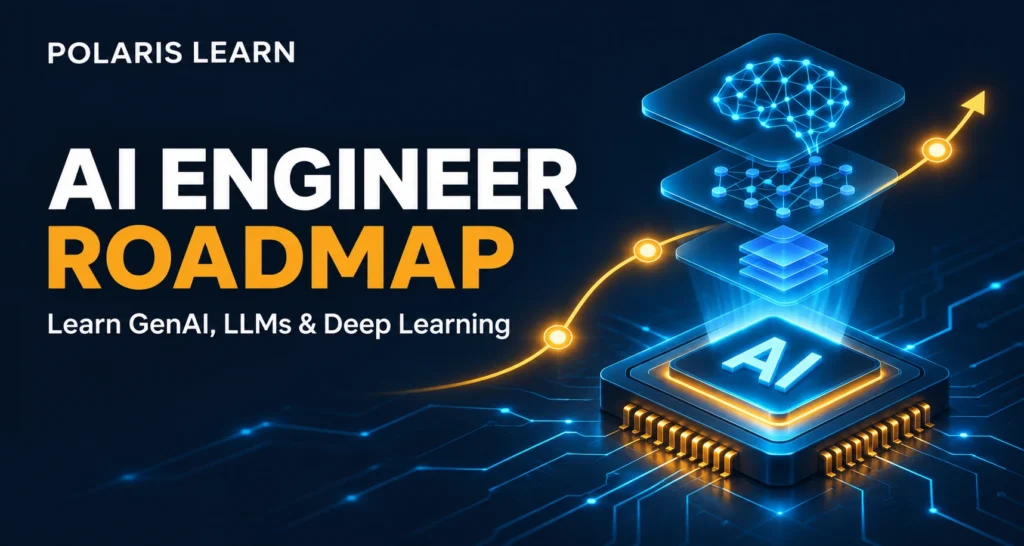
That is why a useful learning roadmap should cover programming, machine learning, deep learning, Generative AI, and software development.
1. Get comfortable with Python before you go into AI.
If you have never done any programming before, give yourself time to learn Python properly. You’re going to use it to manipulate data, build models, and build AI applications.
Start with the basics : variables , loops , functions , lists , dictionaries, and file handling . How to write small programs yourself, not using code generated by AI tools
Once you are comfortable, try out NumPy and Pandas. They come in handy when working with data sets, cleaning information, and doing calculations.
You don’t need to be an expert programmer before you go ahead. You should, however, be able to read code, understand what it does, and fix simple errors.
2. Learn how machine learning works
It is tempting to jump directly into Generative AI because that is where much of the attention is today. But machine learning explains several important ideas that also matter when working with more advanced AI systems.
Begin with regression and classification. Then explore clustering, training and testing datasets, overfitting, and model evaluation.
You should also spend some time with probability, statistics, and linear algebra. These subjects may seem theoretical at first, but they become much easier to appreciate when you are trying to understand why a model makes certain predictions.
A good first project: Build a model that predicts house prices using historical data. It is a straightforward way to practise data preparation, training and evaluating a model.
3. Move on to deep learning when the basics make sense
Deep learning is behind many of the advances in image recognition, speech processing and modern language models.
You do not need to study every type of neural network in detail at the beginning. First, you need to understand how a neural network learns, what loss functions are for and why backpropagation is important.
A good framework to look at is PyTorch. Try a few examples and alter them a bit to see how it affects the output. You can look into CNNs, RNNs and the attention mechanism later.
Good first project: build an image classifier or a sentiment analysis model. Understand the process of training rather than just get a result.
4. Now Learn About Generative AI and LLMs
Here’s where it gets interesting for anyone looking to build AI-powered applications.
Learn what tokens, embeddings and transformers are. Understand how an LLM generates text and why it can sometimes produce convincing but incorrect answers.
Then start building with an LLM API. Experiment with prompt design, structured outputs and connecting a model to external information.
One of the concepts you should learn early is Retrieval-Augmented Generation (RAG). The application can pull relevant information out of a set of documents and then create a response. This is useful when building chatbots that need to answer questions about specific material rather than just relying on information learned during training.
As you build, check out tools like Hugging Face and LangChain. Don’t just follow a tutorial; try to understand what each tool is doing.
Good first project: Build a chatbot that answers questions from a set of PDFs. Try asking questions that aren’t found in the documents and see how it performs.
5. Learn how to turn an AI experiment into an application
Many beginners have a few notebooks on their computers that demonstrate machine learning or LLM experiments. The next step is to make those projects usable by someone else.
Learn how APIs work and try building one with FastAPI. Understand how to manage dependencies, use Git and deploy an application. Docker is worth exploring when you are ready to package your project.
You should also become familiar with the basics of monitoring and maintaining AI applications. A model may behave differently when it receives new data, and an application can slow down or become expensive as usage increases.
A good first project: Take your document chatbot and turn it into a small web application that someone else can access and use.
Projects That Can Help You Practise
Instead of building ten projects that follow the same tutorial, choose two or three and keep improving them.
| Project | What you will learn |
| House price predictor | Data preparation, regression, evaluation |
| Image classifier | Neural networks, model training |
| PDF question-answering chatbot | LLMs, embeddings, RAG |
| Resume analyser | Text processing, structured outputs |
| AI research assistant | Retrieval, summarisation, application development |
Put your work on GitHub. Explain what the project does, how you built it, and what problems you encountered. A project does not have to be complicated to be worth showing. It should demonstrate that you understand the work behind it.
How Much Time Does This Roadmap Require?
There is no fixed timeline for learning AI engineering. Someone who already knows programming may move through the topics faster than a complete beginner.
As a rough starting point, you could spend the first month on Python and mathematics, the next one or two months on machine learning and deep learning, and the following months exploring LLMs, building applications, and learning deployment.
The important thing is not to rush through every topic. If you cannot explain how your model works, spend more time with it before moving on.
Frequently Asked Questions
Can I become an AI engineer without prior experience?
Yeah. Begin with programming and basic mathematics. Then progress to machine learning, deep learning, and generative AI. Learning with building projects will help you to understand the concepts.
Should I learn Machine Learning or Generative AI (first)?
If you want to build AI apps fast, you can get an early start by tinkering with Generative AI tools. However, getting to know the basics of machine learning will give you better insight into how standard artificial intelligence systems work and how to gauge their performance.
Is Python enough to get into AI engineering?
Python is a great start, but you will eventually need to know about machine learning, data handling, AI Frameworks, APIs, and deployment. Not so much about learning a programming language on its own, but the combination of these skills.
What’s the difference between AI engineer and machine learning engineer?
A machine learning engineer is often focused on developing, training, and deploying standard models for machine learning. An AI engineer may also integrate existing models, develop LLM-powered applications, and build systems that utilise AI to solve practical problems. The tasks overlap in many companies.
What can I do to prepare for AI engineering interviews?
Be able to speak about your projects and the decisions you made while building them. Revise Python, data structures, machine learning concepts, and basic maths. For roles involving GenAI, prepare to discuss LLMs, embeddings, RAG, and the limitations of AI-generated responses.