Last updated:
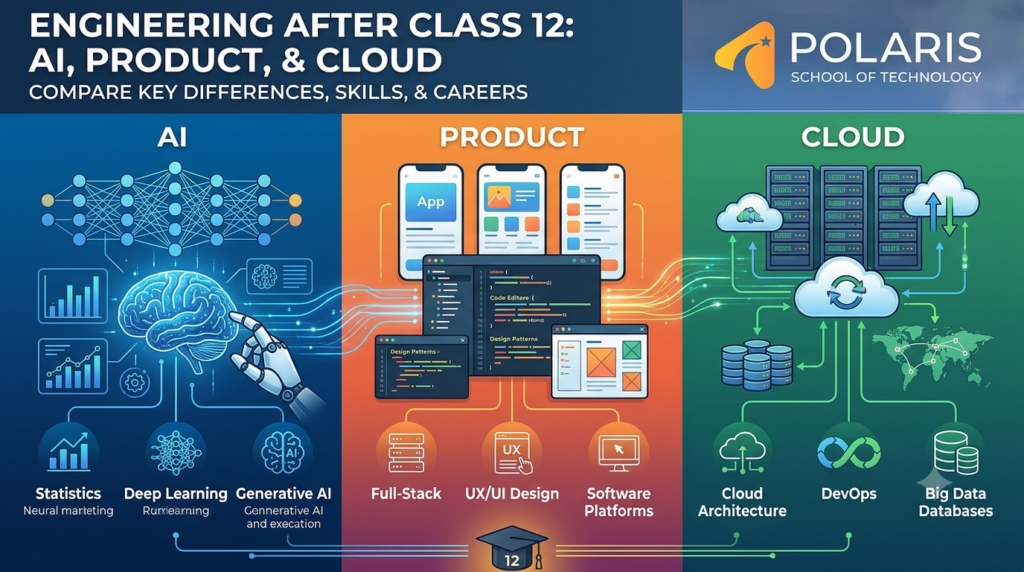
Choosing an engineering specialisation after Class 12 is an important decision, especially with the growth of technology careers. Artificial Intelligence (AI), Product Engineering, and Cloud Engineering are three of the most popular career paths, but they all focus on different skills, technologies, and job roles. So AI Engineering is about building intelligent systems, Product Engineering is about building software products, and Cloud Engineering is about managing the infrastructure that makes the applications run.
To choose career options, will depend on a variety of things like a student’s interest, his or her skills and future career plans. It is important for students to know the nature of the fields in question, the skills required for the fields and the career prospects related to them. That’s where institutions like the Polaris School of Technology come in handy.
AI Engineering vs Product Engineering vs Cloud Engineering: Key Differences
Before selecting a specialisation, students should understand the kind of work involved in each field. Although all three are part of Computer Science and Engineering, they focus on different areas of technology.
1. AI Engineering – This covers the full range of constructing intelligent systems that can learn from data, understand information and execute tasks that usually require human intelligence. Including machine learning, deep learning, generative AI and computer vision.
The programme is for Maths geeks, programmers and those interested in data and intelligent technologies.
2. Product Engineering – This programme is focused on the design, development and enhancement of digital products such as mobile apps, websites and software platforms. This programme includes programming, user experience and problem solving.
The programme is intended for lovers of programming and application developers.
3. Cloud Engineering – The programme addresses the design and maintenance of online infrastructures that host and process data and applications. The programme covers topics such as cloud architecture, databases, DevOps and distributed systems.
It’s a programme for those who like networking and databases.
Comparison of AI, Product and Cloud Engineering
The following table highlights the major differences between these three engineering specialisations.
| Factors | AI Engineering | Product Engineering | Cloud Engineering |
| Main focus | Intelligent systems | Digital products | Cloud infrastructure |
| Key subjects | ML, Deep Learning, GenAI | Full-stack development, UX, system design | Cloud architecture, DevOps, Big Data |
| Important skills | Python, Statistics, Data Analysis | Programming, Design Thinking, Problem-solving | Linux, Networking, Databases |
| Typical projects | AI chatbots, recommendation systems | Mobile apps, SaaS platforms | Cloud-based applications, data pipelines |
| Career options | AI Engineer, ML Engineer | Product Engineer, Software Engineer | Cloud Engineer, Platform Engineer |
Go through, How to Become Cloud Engineer after Class 12
How to Choose the Right Engineering Specialisation After Class 12?
Choosing a specialisation should not depend only on which field is trending or which one appears to offer the highest salary. Students should consider their interests, preferred working style, technical strengths and the kind of problems they want to solve.
1. Identify Your Interests and Strengths
Begin by knowing the kinds of things that you like to do. There is no requirement that you must know everything about programming and technology before enrolling in any engineering class. However, it will help if you have some level of curiosity when it comes to learning these things.
- Go for Artificial Intelligence Engineering if you love math, logical thinking, data and machine learning.
- If you enjoy building applications, solving problems and developing technologies to be put to practical use, then Product Engineering is for you.
- If you love learning how websites, applications, databases and other online systems work, then Cloud Engineering is the right choice.
2. Understand the Subjects You Will Study
Each specialisation has its own curriculum. Students are advised to look at the subjects which are covered in the programme rather than taking a course based only on the name of the course.
| Specialisation | Important Subjects |
| AI Engineering | Python, Machine Learning, Deep Learning, Computer Vision, Generative AI and MLOps |
| Product Engineering | Data Structures, Full-Stack Development, System Design, UX, Product Strategy and Experimentation |
| Cloud Engineering | Cloud Architecture, Networking, Big Data, DevOps, Distributed Systems and Data Engineering |
Check, Career Paths After Studying Applied AI Engineering at Polaris
3. Consider the Type of Career You Want
Consider the activities that you want to undertake upon completion of your degree. Each specialisation opens up various career options for you.
| Your Career Interest | Suitable Specialisation | Possible Job Roles |
| Building intelligent applications | AI Engineering | AI Engineer, ML Engineer, GenAI Developer |
| Creating software and digital products | Product Engineering | Product Engineer, Software Engineer, Tech Lead |
| Managing large-scale technology systems | Cloud Engineering | Cloud Engineer, Cloud Architect, Platform Engineer |
4. Check Practical Learning and Industry Exposure
Engineering is more than simply classroom learning. Students need opportunities to use their knowledge through building projects, working with industry tools and solve real world problems.
- Practical projects in the selected specialisation.
- Access to industry technologies, platforms and tools.
- Internships and work experience with companies.
- Mentoring by seasoned technology professionals.
- Opportunity to work on independent projects and participate in hackathons.
5. Look at the Long-Term Learning Opportunities
Technology changes very fast and engineers have to keep learning throughout their career. Students need to choose a field that they would like to pursue beyond their degree.
AI Engineering, for example, requires staying on top of new AI models and machine learning techniques. Product Engineering requires understanding of changing user expectations and software development practices. Cloud Engineering requires you to learn new cloud platforms, security practices and infrastructure technologies.
There is no specialisation that guaranties a successful career. Consistent learning, technical knowledge and practical experience are important for long term growth.
How Does Polaris School of Technology Help Students Choose the Right Specialisation?
With limited exposure to AI, Product and Cloud Engineering, it can be difficult to choose between these fields. Polaris School of Technology offers a four year Computer Science programme with three specialised learning tracks to deal with this.
The programmes are built around practical technology skills, industry exposure and project based learning. Students can select for a specialisation according to their interests and the type of engineering career they wish to follow.
1. Applied AI Engineering with Microsoft
The Applied AI Engineering programme is suitable for students who want to build intelligent applications and work with emerging AI technologies. The curriculum covers:
- Machine Learning and Deep Learning
- Generative AI and AI Agents
- Computer Vision
- AI Ethics
- MLOps
Potential career paths: AI Engineer, Software Development Engineer, Applied AI Researcher and ML Platform Engineer.
2. Product Management and Engineering with Amazon Web Services
This specialisation is designed for students who want to combine technical development with product and business understanding. It focuses on building software products while understanding user needs and business goals.
- Product Strategy
- Full Stack Development
- System Design
- User Experience (UX)
- Experimentation
- Growth Marketing
Career options: Product Engineer, Product Manager, Tech Lead, and Startup Founder.
Also learn about, What is Product Management Engineering
3. Cloud and Big Data Engineering with Google Cloud, AWS and Microsoft
This programme is suitable for students interested in cloud infrastructure, data systems and large-scale applications. It focuses on the technologies that help companies store, process and manage large amounts of data.
- Cloud Architecture
- Big Data
- DevOps
- Distributed Systems
Potential career paths: Cloud Architect, Data Engineer, Platform Engineer and Solutions Architect.
How Polaris School of Technology Supports Practical Learning?
In addition to curriculum design, Polaris School of Technology also tries to develop skills through hands-on experience of learning for students. Some of the key aspects of learning at Polaris are as follows:
- Industry partnerships: The specialisation programmes are offered in partnership with technology companies like Microsoft, AWS, and Google Cloud.
- Project based learning: Learning through projects in technology to gain practical knowledge and skills.
- Industry mentoring: Learning opportunities with industry professionals through industry mentoring programmes.
- Internships: Opportunities for industry internships, from the first year.
- Startups: Learning entrepreneurship and product development through the ecosystem of startups.
Which Engineering Specialisation Should You Choose?
There is no specific engineering discipline suitable for all students. The one depends on the work a student likes and skills they wish to learn.
- Choose AI Engineering if you wish to deal with machine learning, Generative AI, intelligent applications and technologies based on data.
- Choose Product Engineering if you like to create software products, applications and use your technological knowledge to solve business problems
- Choose Cloud Engineering if you like cloud computing, data infrastructure, distributed systems and applications.
Choose between AI engineering, product engineering and cloud engineering after Class 12 FAQs
1. Which stream to opt for after Class 12?
There can’t be one specialisation for all the students. AI engineering will be good for students who like machine learning and intelligent systems. The best option for students who like to create applications and software is product engineering. For students who want to pursue cloud computing, cloud engineering is the best option.
2. Do students need to have coding background to choose AI, product or cloud engineering?
Yes, students do not need any prior professional experience in coding to join engineering. Most undergraduate programmes teach the fundamentals of programming first, before moving on to more specialised topics. “But a logical way of thinking and interest in math can make the process easier.
3. What qualifications are necessary for studying AI, Product or Cloud Engineering after Class 12?
The students can enroll in these courses through the Undergraduate program, which includes Bachelor of Technology in Computer Science Engineering or related branches. The eligibility criteria vary from college to college and course to course. Mostly, a Bachelor of Technology course demands Physics and Mathematics subjects in Class 12 and other subjects as well.
4. Which engineering discipline gives good career prospects, AI, Product or Cloud Engineering?
Each of the above disciplines has its own scope of jobs in the technology sector. AI Engineers have an opportunity to work in Machine Learning, Generative AI and intelligent systems whereas Product Engineers can pursue careers in software development and digital product creation. On the other hand, Cloud Engineers have an option for cloud infrastructure and DevOps.
5. Can students switch to Product or Cloud Engineering from AI Engineering later?
Yes. Students can cross over these areas by acquiring the technical skills that are required and by obtaining project experience that is relevant. All three specialisations have some shared core subjects, including programming, data structures, databases and computer science fundamentals.